About us
Horizon aims to be a space for Irish Marxists to engage in open debate, critically examine our ideas, and collectively advance the struggle for socialism.
About us
Horizon aims to be a space for Irish Marxists to engage in open debate, critically examine our ideas, and collectively advance the struggle for socialism.

Bernie McAdam is a People Before Profit activist and a member of the International Socialist League.
Ireland: Republicanism & Revolution was written by Alan Woods in 2005 as a response to the new political situation opened up by the Good Friday Agreement in 1998. Alan Woods himself is a leading member of the Revolutionary Communist International (RCI), an international group which has recently established a section in Ireland known as the Revolutionary Communists of Ireland. His book is widely promoted by the group and deserves the attention of all Marxists seeking to understand the national question in Ireland and in building a party fighting for a Workers Republic.
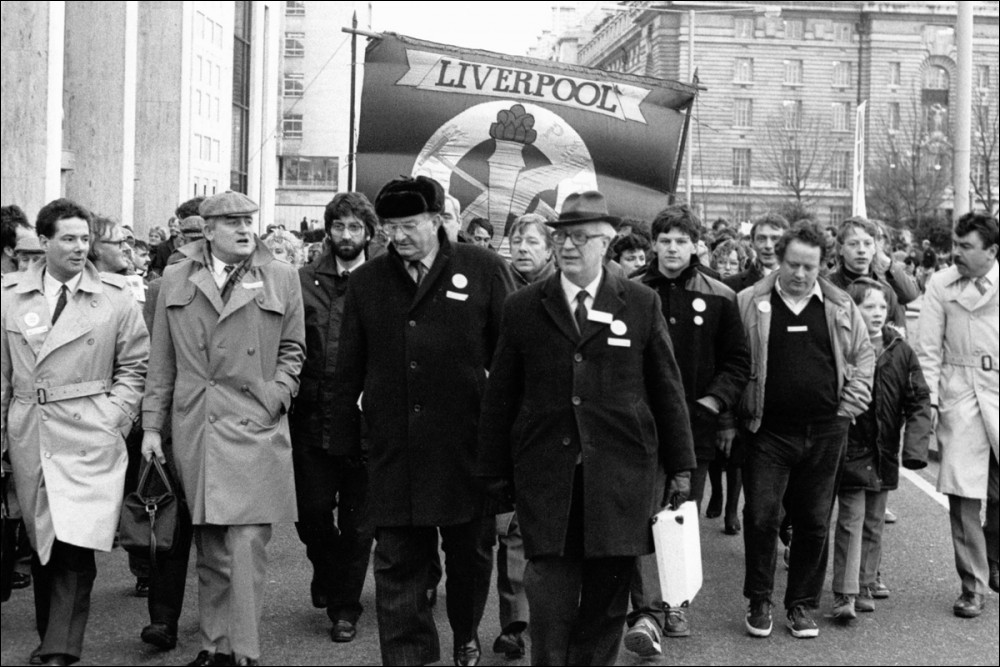
Alan Woods’ political roots lay in the Militant Tendency, a tendency best known for their control of Liverpool council in the 80’s. His mentor was Ted Grant and together they had split from Peter Taaffe’s Committee for a Workers’ International (CWI) in the early 90’s and formed the International Marxist Tendency, the precursor to the RCI. The CWI has fractured and fragmented and now spawns several groups in Britain and Ireland which trace their heritage back to Ted Grant’s Militant. It is therefore a significant international tradition that warrants serious consideration.
In an attempt to understand the most recent conflict, Woods analyses key episodes in Ireland’s history very much through the eyes of James Connolly’s works. He lauds ‘the ideas of James Connolly as correct in all the fundamentals’. In addressing the recent struggle against the northern state he also unapologetically draws on the politics of Ted Grant’s Militant Tendency from whence he came. This, as we shall see, is a serious flaw for a relatively ‘new’ group attempting to rebrand itself as revolutionary communist.
James Connolly was the founder of Marxism in Ireland. His extensive writings on the role of labour in Irish history were combined with a lifetime of intervention into the working class struggle where he sought to give a socialist consciousness and practical leadership. As a leader of Dublin workers during the Lock Out of 1913, he helped organise the defence of workers through the union’s Irish Citizen Army (ICA). He also fought for the Irish working class to champion national freedom and was eventually executed by the British for leading the ICA into battle during the Easter Rising of 1916.
As Irish Marxists we stand on Connolly’s shoulders. But this doesn’t mean we have to acclaim every aspect of his role at the time. Woods correctly criticises Connolly’s failure ‘because he did not create – as Lenin created – the necessary instrument with which to change society: a revolutionary party and a revolutionary leadership!’.1 But for Woods this is merely an organisational failure and not rooted in Connolly’s political method. Woods fails to root the problem in Connolly’s syndicalism: the belief that One Big Union (the ITGWU) would be the primary weapon in the abolition of capitalism thereby demoting the task of building a party and developing a programme.
Connolly innovatively linked the national to the social and economic question, summed up in the maxim, ‘the cause of Labour is the cause of Ireland, and the cause of Ireland is the cause of Labour’.2 Unfortunately for Connolly this became a way of collapsing the working class struggle for socialism into revolutionary nationalism. He retrospectively reads this narrative back into Irish history so that the national struggle throughout the different ages became a class struggle of the toilers against the foreign imposition of private property. This suits Woods’ narrative that Irish Republicanism contains two contradictory tendencies: a betraying bourgeois one and a revolutionary working class tradition.
So for example Connolly portrayed Wolfe Tone as the champion of ‘the men of no property’ when the United Irishmen rose up against the British in 1798. As opposed to the bourgeois reformers and constitutional nationalists that backed Henry Grattan, the United Irishmen were called revolutionary democrats and internationalists. Woods accepts this, portraying Tone and the oppressed masses as having ‘waged a class war against the aristocracy’ until the Irish bourgeoisie betrayed it.3
This is so simplistic as to be inaccurate. Tone represented the revolutionary wing of the Irish bourgeoisie rather like Robespierre in the French Revolution of 1789. This revolution saw a thoroughgoing bourgeois revolution against feudalism and absolutism. It was the masses not the bourgeoisie that was the key engine of the revolution, but it was the Jacobins, who were the most revolutionary wing of the bourgeoisie, that led the revolution and saved it from the counter revolution and ushered in a new capitalist state. This was a revolution of all the progressive classes of the nation including the bourgeoisie.
The United Irishmen were the equivalent of the Jacobins; they were the revolutionary wing of the Irish bourgeoisie set against the aristocracy. Their rebellion may have been defeated, but they didn’t betray it. Their leaders were prominent merchants and business owners, and Tone spoke of a new republic in terms of ‘abounding in all the necessary materials for unlimited commerce’, that is in terms of the bourgeoisie’s interests rather than the masses’ interests.4 Tone, like Robespierre, was certainly prepared to mobilise the ‘men of no property’ but this does not mean ‘that his programme was defined centrally by their interests’. Woods like Connolly tries to paint the movement up as essentially plebeian without looking at its bourgeois aims and objectives.
According to Woods, Connolly and the Irish Citizen Army ‘played the leading role in the Rising’ and ‘the driving force for the uprising was the Irish working class, fighting not just for Irish independence, but for the Irish Workers’ Republic’.5 This is a misleading and fanciful portrayal of the Rising. Of course, Connolly’s ICA played a hugely significant role but they were 220 out of 1,300 insurgents; the largest component belonging to the Irish Volunteers under the leadership of the Irish Republican Brotherhood (IRB) alongside the women volunteers of Cumann na mBan. Woods does not mention this at all. He downplays this revolutionary nationalist component of the Rising as he focuses entirely on only those nationalists, like Eoin MacNeil, that on the eve of the rebellion, betrayed and demobilised it.
Woods certainly exaggerates the role of the working class but then he himself acknowledges that after the Dublin Lock Out of 20,000 workers (August 1913 – January 1914) their organisations ‘had been exhausted’.6 In relation to Connolly he notes there were other serious weaknesses in the Rising, like not calling for a general strike or not making appeals to rank and file British soldiers. Connolly was no doubt the most resolute leader, but his alliance with the IRB was a political and military dissolution of the ICA into a nationalist rebellion. It was not ‘uncompromising class independence’.7 There were no calls to the working class for independent action and a jointly written Proclamation was a statement of democratic aims not socialist ones. Despite that Lenin correctly still supported the Easter rebellion but it cannot be dressed up as a fight for ‘the Workers’ Republic’. This amounted to a conscious decision by Connolly to lower the red flag to the green.
Connolly had not forgotten his 1897 view that if you “hoist the green flag over Dublin Castle, unless you set about the organization of the Socialist Republic your efforts will be in vain. England will still rule you. She would rule you through her capitalists, through her landlords, through her financiers..”.8 In the Workers Republic 8 April 1916, less than two weeks before the Easter Rising,
‘The cause of labour is the cause of Ireland, the cause of Ireland is the cause of labour. They cannot be dissevered. Ireland seeks freedom. Labour seeks that an Ireland free should be the sole mistress of her own destiny, supreme owner of all material things within and upon her soil. …..and to secure that end would vest in that free Irish nation all property rights as against the claims of the individual,..’.9
The real problem was not Connolly’s support for the uprising but the weakness of his preparation of the working class via a revolutionary party. Such a party would have needed to combine the industrial militancy of the Irish Transport and General Workers Union, which he and Larkin led in 1913-14, and the fighting strength of the ICA with a clarity of programme which saw a workers government as the goal that could achieve meaningful independence and unity for Ireland. But what occupied the place of a revolutionary party in Connolly’s strategy was a broad electoralist Labour party. It would, of course, be ahistorical to blame Connolly for this since only Lenin and Trotsky were able to establish and apply this strategy, a year later, because Lenin – uniquely within the Second International – had forged the Bolshevik party. But we, a century or more later, have no excuse for not drawing these lessons.10
After the Rising and Connolly’s execution, Woods informs us that under bourgeois and petit bourgeois leadership, ‘the movement was side tracked into a guerilla struggle’.11 Again he downplays the character of the nationalist rebellion. This hardly tells the full story of the revolutionary ferment across Ireland with large parts of the British civil administration paralysed.
A new republican government with the Dáil and courts were established of which the IRA became its army. It also included workers’ struggles against the British state. Even with the guerilla war at an impasse, the British would have faced real difficulties in re-occupying southern Ireland if a Treaty had not been agreed. By the time the Treaty was agreed, workers were on the defensive in Ireland and in Europe. It was not as Woods says ‘the fear of revolution’, that prompted the British to sue for peace.12
Woods devotes one paragraph to the working class and land struggles during the War of Independence but nothing on how these struggles could be won. These were often part of the national struggle, e.g.general strikes in support of republican hunger strikers, against transport of the British military, the Limerick Soviet of April 1919, etc. but it is these struggles that are crucial to how the strategy of Permanent Revolution could be applied. Woods correctly rejects the two stages model which invests the bourgeoisie with the task of solving the national democratic revolution and he is formally in favour of Permanent Revolution. He however abstractly poses it in a way that skips over the question of intervening in the national struggle, as solving it can only occur as ‘a by-product of socialist revolution’.13
Applying Permanent Revolution in practice would pose the question of an anti-imperialist united front with revolutionary nationalist forces which would require a decisive lead by the working class, alongside rural labourers and small farmers, that could have built democratic councils of action, defended by a workers’ militia on the road to a Workers’ Republic. In this way the IRA’s actions could have formed part of – and been subordinate to – a mass armed rebellion, rather than a purely guerrillaist strategy. But such a lead would have required a Bolshevik-style party with a programme of social and economic demands linked to the struggle for national independence.
The failure of Ireland’s National Revolution and the resulting partition of the country set the scene for a British colonial state with inbuilt and systematic discrimination against all those who identify as Irish. This directly accounts for the mass anti-unionist revolt in the North between 1968 and 1998. Woods’ narrative of this struggle against the six county state between 1968 and 1998 is essentially a restatement of the Militant Tendency’s line. The progressive potential of the mass Civil Rights Movement in the North in the 1960s is acclaimed but it lacked class demands which could unify the working class on a non-sectarian basis. We would agree that all class demands were vital, but any struggle for equality was always going to come up against the source of sectarianism – the northern state and the Unionist class bloc uniting Protestant workers to their exploiters. Since that state was British and created to thwart a united Ireland and enforce discrimination in jobs, housing and more against the Catholics, it was inevitable that the national question would come to the forefront of the struggle. The question was how revolutionary socialists should give a lead to that struggle.
This caught the left in Britain and Ireland by surprise, not just Militant, as they all failed to pose and attempt to give a socialist lead in that struggle. For Militant, though, any element of national struggle is falsely equated with sectarianism in particular the armed struggle against the British army of occupation and the legitimate defence against the ‘Orange’ murder gangs. They failed to recognise that sectarian discrimination in the north was, in fact, national oppression. Woods defends this legacy. So, á la Grant, the Provisional IRA guerilla campaign was dubbed ‘individual terrorism’ whose effect was to ‘exacerbate sectarianism’.14
But unlike Militant, he seeks to elevate a second group within Republicanism: the ‘socialist republicans’, like Seamus Costello ‘who had the correct approach’ and Thomas “Ta” Power (IRSP/INLA) rather than the IRA, whom he brands ‘a bourgeois right wing trend in Republicanism’.15 If Woods thinks this gives him left cover, then he should tell us what differentiates the INLA armed campaign from the IRA’s ‘individual terrorism’. The fact that it was led by socialist republicans? In fact the INLA campaign was a similar guerilla struggle, though smaller but over time equally divorced from the needs of the masses – be it their social and economic conditions or their defencelessness against state repression. This does not in any way prevent revolutionaries from criticising guerilla warfare as a dominant strategy, and distinguishing this from necessary armed defence by a community under attack by 21,000 British soldiers and over 8,000 RUC officers, not to speak of the UDA and UVF gangs.
Apart from this brief detour into the IRSP, Woods, like Grant, fails to understand why Marxists use the term ‘individual terrorism’. This term refers to military actions taking place outside of a mass movement, there is no action by the masses to which it relates. In no sense can this be applied to the tactics of the IRA between the introduction of internment and the fall of Stormont in 1972. The IRA had mass support as they were seen as the only defenders of Catholic areas, and military actions took place as part of a war which also included other actions of the masses, rent and rates strikes, street battles, and more. Actions that ultimately brought Stormont down. As such it was a justified war against the Orange state and part of a mass movement to drive Britain out, to which Marxists should have given unconditional but critical support. Militant failed that acid test.
It was the internationalist duty of the British left to build a solidarity movement with all those struggling against ‘its’ state, not just to counter anti-Irish chauvinism in the British working class, but to weaken that state in its repression and occupation of the six counties. This the British left failed to do. Incredibly, Woods argues the main problem was the British left’s support for the IRA e.g. inaccurately accusing the Socialist Workers Party (SWP) of being ‘uncritical cheerleaders’ of the Provos.16 Ironically the IS (SWP) after the Aldershot bombing in 1972 also described the IRA actions as ‘individual terrorism. Having correctly admonished the left for welcoming British troops in 1969, he then completely ignores the dismal record of all the major left groups – Militant, the SWP and the WRP – in building an anti-imperialist Troops Out current within the British labour movement.
Woods treats the movement behind the Hunger Strikers of 1981 a little more sympathetically, but nowhere does he criticise Militants appalling record at the time – a tendency that often attacked such mobilisations as reactionary and sectarian. When 100,000 marched against Thatcher’s murder of hunger striker Bobby Sands, Militant’s front page condemned the fact that ‘sectarian organisations’ had thereby achieved worldwide prominence.17
This perfectly illustrates Militant’s accommodation to the official organs of the trade union and labour movements, which were dominated by collaborators of British imperialism and Unionism in the north. The ‘unity’ between Catholic and Protestant workers in the unions rested on a tacit agreement to ignore Protestant privilege, sectarian discrimination and the national question. The lesson of Militant’s practice during these years is that working-class unity cannot be fostered by just abstractly appealing to common economic interests or tailing the pro-Union agenda of the unions and the Northern Ireland Labour Party.
Class consciousness does not automatically or spontaneously spring from trade union struggle. Lenin called this approach economism, and it explains why Militant failed as a socialist group to take up the issues of the oppressed in a revolutionary way. Be it against imperialism, but also against racism, women’s oppression, LGBTQ oppression and more. Rather than recognising that these oppressions, that are embedded in workers’ consciousness by bourgeois society – divide the fighting power of the working class, Militant treated the movements fighting back against them as the danger.
Despite Woods’ reluctance to do so, the RCP have elsewhere distanced themselves from the Militant/Socialist Party. In a critique of Peter Hadden’s ‘Common History, Common Struggle’ Ben Curry argues that Militant sought to ‘downplay the role of and the revolutionary elements contained within the tradition of Republicanism and to exaggerate the role of organised labour’.18 Hadden’s crazy call for separate Protestant and Catholic ‘socialist’ states is roundly condemned. This critique, however, is severely limited and falls short of a full reckoning with Militant’s economistic method and its reactionary positions on the national question.
Alan Woods’ book falls well short as a Marxist analysis of Irish history. He has not paid due diligence or research into any critical Marxist biographies of Connolly. His treatment of nationalist rebellions exaggerates either their ‘revolutionary’ character or the role of certain leaders so as to justify his support for such movements. Several historical inaccuracies are introduced to fit this schema. Yet when an actual rebellion against the British northern state takes place, led by the armed campaign of the Provisionals, this is characterised as ‘individual terrorism’ deserving of no support.
Lenin was quite clear on those ‘Marxists’ that could not support struggles against imperialist powers; he called the trend ‘imperialist economism’. In supporting national self-determination he said, ‘socialists cannot – without ceasing to be socialists – reject such a struggle in whatever form, right down to an uprising or war’. Of course, this was never an excuse for Lenin to tail non-working class forces.19
Woods then uses this false dichotomy of good and bad wings within Republicanism to determine his level of support, rather than unconditionally supporting the right of oppressed peoples to fight imperialism regardless of their leadership. Of course Republicanism has contradictory tendencies, class tendencies, and revolutionary versus constitutionalist ones, but a Marxist analysis would consider all varieties of Republicanism and nationalism as cross-class, insofar as the nation comes before class and that the struggle against capitalism is secondary within their practice. As imperialism emanates from the capitalist system, they therefore are not consistent anti imperialists. The communist answer is not to separate themselves from that struggle, as Militant did, but to intervene in such rebellions with its independent programme and party on the road to a Workers’ Republic.
Woods does end with a call for ‘a fighting working class movement in Ireland’ and a revolutionary organisation ‘soundly based on the programme, policy and methods of Marxism’.20 At that level of generality we can agree. But there is no evidence that such a programme, based on applying the strategy of Permanent Revolution, has been produced by the RCI nationally or internationally. Judging from Woods’ book, there is no evidence that such a programme would serve as a guide to action or carry the correct orientation toward the national question in Ireland. There is no critical account of Militant, only recent superficial embellishments. Connolly heroically established this positive link between national and social freedom, whatever the weaknesses, but the Grant tradition, despite the Connolly adulation, flunked this task completely. It is however a task that remains urgent today. Ireland’s national struggle remains unfinished, and communists must elaborate a revolutionary programme that incorporates our demands to solve the national question. That, too, is an unfinished task!
If you want to get in contact with a submission or a response to the above review reach out at contact@horizonmag.ie
