About us
Horizon aims to be a space for Irish Marxists to engage in open debate, critically examine our ideas, and collectively advance the struggle for socialism.
About us
Horizon aims to be a space for Irish Marxists to engage in open debate, critically examine our ideas, and collectively advance the struggle for socialism.

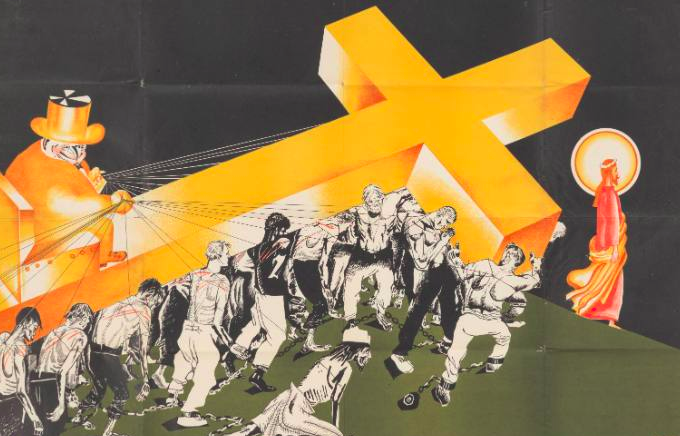
Religion and Marxism clash frequently, both on the interpersonal and international level. It seems every couple of months, the same debate washes over the online left about whether one can be both a devout Muslim/Christian/Jew, and be a consistent socialist. This is nothing new. The Cold War was often framed as a battle between the God-fearing West and the Godless East. The relationship has been longstanding. Present day Communist and socialist parties have been inconsistent in their approach to the issue, especially where the boundaries of the matter begin to blur with those of state secularism and racial and religious bigotry.
This has not always been the case, however. The socialist movement, despite its divisions, used to be quite united on the question of religion and its place not only in the programme, but within the life of the party and movement more broadly. The Irish Left, given the recency of the Church’s domination, has been gracefully anti-religion for far longer than a fair amount of its international contemporaries. Nevertheless, as the left continues to grow, old questions raise their familiar heads. To address this, we must look back into our shared past so that it may illuminate our collective future. I will analyse the history of the relationship between religion and socialism, from Marx and the second international, through to the application of some of these ideas in our two case studies, the USSR and France.
Marx’s words are often taken out of their textual context, and few lines have been more liberally thrown around (and conveniently re-written) than his famous words on religion: “Religion is the sigh of the oppressed creature, the heart of a heartless world, and the soul of soulless conditions. It is the opium of the people”.1 These two sentences have been interpreted in many ways. Opium, of course, is today as much if not more so associated with addiction as it is with pain relief. Some, such as Roland Boer, would argue that contemporaneous understanding of opium in Marx’s time would have been primarily that of pain relief.2 While it is true that opium was not as stigmatised then as it is now, it was still understood to be a substance that could be abused. Even if ‘addiction’ as a medical category wasn’t fully articulated at this point in time. Importantly, this can be seen in Marx’s own words. Not a line later, he writes:
“The abolition of religion as the illusory happiness of the people is the demand for their real happiness”3
Religion, like Opium, is understood by Marx to be an “illusory happiness”. Nevertheless, this is not the sardonic critique of the New Atheists, nor is it a get out of jail free card for those Marxists who believe that they can marry their religious inclinations to their radical politics. It’s a scientific recognition of the reality of religion as a social phenomenon, as something that people in desperate situations will often cling on to and embrace as a source of comfort; something that is ultimately determined by their conditions, that Marx puts as “requir[ing] illusions”.4 He correctly deduces that for the illusion to disappear, the condition that requires it will have to disappear too.
Marx’s writings on religion, as sparse as they were, were understood in a fairly consistent manner by the prominent theorists of the Second International, particularly those within its preeminent party, the SPD. The SPD’s programme was clear. Religion was to be a private affair. The social democrat was to advance secular ideals, and support secularising policies in public life, but when it came to the private convictions of the individual, the programme had little to say.5 While this was the standard position amongst the second international, there was not always absolute agreement, and interestingly opposition often came from an angle one might not expect. As August Bebel recalls in his short letter to the British Social Democratic Federation’s paper, ‘Social Democrat’, there were some in the SPD, personified here by a ‘Comrade Welker’, that sought to take a stronger and harsher line on religion in their propaganda efforts against the Catholic Centre, a Catholic conservative party active in certain parts of Germany.6 Bebel argued that to engage in a sort of concerted and direct ‘Kulturekampf’ against Catholicism, in an effort to hamper the Catholic Centre Party, would not only simply go against the programme of the party, but would go against the logic behind it too. Social democrats opposed the intermingling of religion and the public powers of the state; they wished to see a separation, wherein every man may believe what he so chooses. So, if the party was to be opposed to such coercion at the state level, it would only make sense that this would translate to the party level too. Bebel ultimately stressed “that in religious questions we must observe absolute neutrality and nothing but neutrality”.7 For Bebel, the battle against the Catholic Centre was one of politics, not philosophy. A man could be a catholic, but still a social democrat and oppose that party on class grounds. In opposing Comrade Welker, this is what Bebel sought to defend.
Karl Kautsky, in addressing similar questions, approached the issue from a sociological angle. He noted that while Christianity indeed did have its origins amongst communistic communities of often celibate worshippers, the church that emerged onto the world stage was one that opposed all revolutionary change.8 It would bow to those revolutions that were victorious, as it did in its totality to the bourgeois revolutions (often at the barrel of a French or Italian Musket), but it would resist every effort at change. And when it came to it, the Church would back every reactionary movement, no matter how vile, even against the classes that would have at a time used it to their advantage. Kautsky argued that this was because the church longed to return to its height during the medieval period, an ultimately doomed wish. It was thus condemned to forever be a reactionary force in society. Its few communitarian aspects that remained from its pseudo-communistic origins were only so useful to it as they were effective at drawing away the dispossessed and hungry from the ranks of the revolutionaries.9 This is most true of the so-called ‘Christian socialists’, those who wish to intermingle their socialist politics with their religious convictions. At every turn these ‘socialists’ will be opposed to class struggle and class warfare, but hide it with a veneer of concern, genuine or otherwise, for the state of the oppressed in our society. The end result is little different when compared to the actions of the rest of the church. Nevertheless, Kautsky makes a similar point to Bebel, that the religious should never be turned away from the party, where they are willing to join the class struggle. Such allies can not be ignored. Ultimately, Kautsky agrees with Bebel. As he quite poetically puts it:
“the proletariat must be in favour of unlimited religious liberty, and must allow every man to go to heaven in his own way”10
For Kautsky, there was marked similarity to be found between the social democratic policy in regard to the army and the state bureaucracy, and the church. Both institutions are objectively reactionary and opposed to proletarian class rule, and thus must be suppressed, but they both are institutions that the proletariat must wield (in a modified and re-constructed form) in the carrying out of its class warfare. The privileges of their officials must be abolished, and the institutions as a whole must be brought under the direct control of the class. The same goes for the church. Their privileges must be abolished; their control of public schools, their influence over charities, etc. However, the socialist should not dream of oppressing the church, instead simply ‘levelling’ it. Kautsky points to the United States of America as a perfect example of such a separation of church and state being carried out to great effect.11
Finally, Kautsky addresses an important point that will become relevant when discussing the Bolsheviks’ attitude towards religious institutions. When the church grows in power in society, it is often as a result of the active neglect of the state; “Is it the fault of the religious orders if, at the present time in France, there are nearly two million children, nearly a third of the children, receiving education at the hands of religious orders?”.12 The comparisons to Ireland are quite clear, wherein 88% of primary schools are still under the local patronisation of the Catholic Church.13 It was self-evident to Kautsky that active, direct repression and violence against the church would be of negligible use, with the reality that even simple ‘perceived’ oppression benefited the church from a propaganda point of view. Therefore, the battle against the church would have to be one that was indirect. By simply taking schooling out of the hands of the church, you would be doing more to diminish its influence than would be achieved by seizing a church or two. “Skill in teaching, and not public opinion, must alone give or refuse the right of teaching” 14– for any rule made against a priest’s right to teach would be used to suppress a socialist teacher talking about queer relationships.
Bebel, Kautsky and the wider Second International recognised that religion was as much a symptom of the harsh reality of the world as it was anything else. An institution wielded by the ruling class as a means of intellectually suppressing the masses, and providing illusory succour for those who suffered much, and that regardless of the material suppression meted out against it, it would survive so long as those same depraved material conditions that gave rise to the suffering it lived off of existed. Social democracy aimed to snuff out the religious flame by depriving it of its fuel.
Though it’s often downplayed, Lenin was a student and participant, if later critic of the Second International, and deeply embedded in its debates, discussions and politics. He was, like his contemporaries, heavily influenced by the SPD and its celebrity theorists, and this is quite clearly reflected in his stance on religion and how the programme of the party should address it. Lenin agreed with the general social democratic position on religion, that it should be a private affair, however in acknowledging this he also critiqued his contemporaries in Germany and elsewhere. He noted, as we have, that the German social democrats put heavy emphasis on the programmatic principle ‘Religion is a private matter’, in so far as public life was to be secular, but the individual was to remain free to believe as he so wished. However, he detected within this a hint of opportunism.
The SPDs strong emphasis on this principle within their programme was as much the result of the circumstances they were operating in as anything else. Bismarck had, between 1871 and 1878, engaged in a political campaign against the Catholic Church, which became known as the ‘Kulturekampf’. Framed by some as a conflict against a reactionary church, the social democrats recognised within it an attempt by the ruling class to obfuscate the class struggle, by getting the workers and peasants to identify with and focus on religious divides more than class divides. In response to this, the Social democrats retained their ideological opposition to religion but sought to subordinate that conflict to the class struggle as a whole. Lenin understood this, and accepted that circumstances had seen the German social democrats bend the stick too far in the other direction, to a point where the full meaning of the programme’s stance on religion was lost in the noise.15
Lenin argued that ‘Religion is to be a private affair’ referred to the Social democratic stance vis-à-vis the State. From the point of view of the State, religion was to be a private affair, but not so from the point of view of the party, or of the committed socialist. The party, Lenin insisted, was to be a thoroughly atheist and materialist organisation. For it, religion was not to be rendered a private matter of one’s conscience, but instead it was to endeavour to develop and maintain an atheistic outlook amongst its members, to continue the fight against the opium of the people, against superstition and the backwards thinking of religion and spirituality. However, as with all things Lenin, we should not think that he was declaring a hard and fast rule here. He recognised, as Bebel and Kautsky did, the dangers of drawing this matter too far.16 The party was not to turn away religious workers, and in fact, it was to seek them out deliberately to educate them and involve them in the class struggle.17 At the end of the day, the class struggle took precedence. The fight against religion was one to be approached with a certain tactical flexibility, even though the party itself was to be strict on maintaining the materialist nature of its programme. To this end, Lenin provides a very good example:
“It is the duty of a Marxist to place the success of the strike movement above everything else, vigorously to counteract the division of the workers in this struggle into atheists and Christians, vigorously to oppose any such division. Atheist propaganda in such circumstances may be both unnecessary and harmful— not from the philistine fear of scaring away the backward sections, of losing a seat in the elections, and so on, but out of consideration for the real progress of the class struggle, which in the conditions of modern capitalist society will convert Christian workers to Social-Democracy and to atheism a hundred times better than bald atheist propaganda“18
In this sense, Lenin, and the Bolsheviks more generally were holding to the orthodox social democratic line on Religion, and when they eventually waged war on the priests, it was because of their counter revolutionary activity, and not because of their belief in god.19
Nevertheless, when in power, the Bolsheviks acted differently. This is somewhat understandable, given that the church was deeply tied not only to the State but the reactionary classes as a whole in Russia. To fight the reactionaries and the white armies, was effectively to fight the church. Early Soviet policy and practice when it came to their attempts to socially engineer a more atheist society were incredibly crude and brash. Again, a certain amount of this was unavoidable. The Patriarch Tikhon pronounced an anathema on the revolutionary government in 1918 when it began to nationalise church property, and officially declared the separation of church and state, measures that were a necessary part of the minimum programme of the Bolsheviks.20 At the same, the Red Army and anti-religious partisans engaged in widespread massacres of priests and bishops. This was mostly out of the control of the central leadership, and would have been hard to untangle from the general repression of reactionary forces that would have taken place during the Red Terror.
One would not be wrong to wonder whether this was a genuine and substantial departure from orthodox Marxist/social democratic policy regarding religion. The social democrats of the Second International made clear that they had no intention of engaging in a direct and violent repression of established religions and their believers, only to see through the separation of church and state so that religion would indeed be a private affair. However, this ultimately highlights the gap that can exist between theory and practice. The Orthodox church was hostile to the Bolsheviks and their allies from the very beginning, and took the most severe actions in response to even the most benign of the Bolsheviks secularising measures. While the revolutionary regime’s existence was still in doubt, they gave open and unqualified support to the white armies, and did so often while preaching the most vile nationalistic and xenophobic rhetoric. A clash between their active reactionary efforts, and the Bolsheviks, was inevitable.
Initially, Bolshevik measures targeted the religious institutions themselves, rather than the individual believers, though as we noted this varied and given the unstable condition of Russia during and immediately after the civil war was not always the case. In fact, it seems that on the ground, anti-religious activism and actions tended to be harsher than the soviet leadership would have wished. The central Committee had to issue, in 1923, a directive ordering institutions to moderate their anti-religious activity, ‘We must take all steps to avoid giving offence to religious feelings, shifting the weight of the work to a scientific explanation of the origin of religious holidays, especially of paska’; this being directed particularly at groups like Komsomol, who would organise anti-religious festivals that mocked peasant traditions.21
There was a turn towards even more direct propaganda as the 20s progressed, aiming to sway individuals away from their religious beliefs. In fact, there was a growing concern amongst the leadership of the Soviet Union that despite the efforts of the revolutionary government, religious affiliation was growing.22 Once again, this would not have been surprising. Russia was only coming out of a brutal civil war; the conditions would have been perfected for an organic increase in religiosity.
Once the stage of direct and violent repression had passed with the civil war, soviet religious policy tended to fluctuate between outright political repression, as was seen during the 30s, to relative openness and tolerance, as happened during the Great Patriotic war. For much of the rest of the Soviet Union’s existence, state atheism came in two parts. Firstly, the general advancement of scientific education and literacy (something which exploded forwards once the space race began), and secondly, state sponsored atheistic propaganda. The latter was a consistent factor of public life up until the 1990s. There were periods where this was relaxed, but in general, religion was effectively persecuted. The former, however, was understood to have been more successful in the overall goal of the secularisation of society, and often the militant atheists themselves noted how ineffective their efforts were.23 This was because when anti-religious activism was tied to scientific education, it tapped into the general populace’s interest in modern scientific advancements. Andrews in ‘Inculcating Materialist Minds: Scientific Propaganda and Anti-Religion in the USSR During the Cold War’” also notes that anti-religious activists in the USSR were unable to properly understand how religious views were able to be reconciled, at least to some degree, with contemporary science and society. What becomes quite evident here, is that direct repression of religion was not an effective means to achieving secularising goals. A broader, and more cultural scientific education combined with a rise in living standards had done more to effect the desired changes, than any of the concerted efforts of state subsidised atheist societies.24 This echoes Engels comments in reference to Blanquists who wished to replicate the efforts of the Jacobins in the outright repression of the church:
“that men should be changed into atheists par ordre du mufti is signed by two members of the Commune who have really had opportunity enough to find out that first a vast amount of things can be ordered on paper without necessarily being carried out, and second, that persecution is the best means of promoting undesirable convictions! This much is sure: the only service that can be rendered to God today is to declare atheism a compulsory article of faith and to outdo Bismarck’s Kirchenkulturkampf laws by prohibiting religion generally”25
My initial conclusion was that the outcome of the USSR’s anti-religious policies, vindicated the Social democrats in enshrining ‘Religion as a private matter’ as policy in their programme. However, the Bolsheviks’ repression of the church during the civil war, does not necessarily signal a break with this policy. Rather, it could be seen as the policy being brought to its natural conclusion when facing conditions similar to those of the Bolsheviks in 1918-1923. The church was, from the very beginning, in its totality opposed to the liberatory programme of the Bolsheviks and their allies. The church opposed every effort at secularisation, no matter how inoffensive, and without need for much convincing, sided with the forces of imperialism and reaction. Still, this does not give justification to the continued active and at times severely harsh repression of religiosity in the USSR after the civil war. In this, they were breaking with the second international, and instead returning to a more Jacobin attitude, the ultimate success of which, as we have seen, was negligible.
“I began, roughly, with the words, “Today, in Britain, religion – fortunately – is not amajor political issue.” Unfortunately, this is no longer the case. Today religion, or rather one religion in particular, namely Islam, is at the centre of political debate.”26
John Molyneux wrote these words almost 20 years ago, and they unfortunately remain as true today as they were then. Religiosity in the west has been, for the last 3–4 decades, on the decline. This decline has not progressed equally everywhere, Ireland having lagged behind until recently. However, even here, church attendance has almost halved since the 1970s.27 This is for a number of reasons, not least of all the numerous church controversies that have to come to light. Nevertheless, it’s also quite clear that at a time when Ireland began to experience genuine economic development, the hold of the Catholic Church began to falter. This has, as Molyneux came to notice, not resulted in the gradual disappearance of religion from the public view in Ireland or elsewhere in Europe. Instead, the question of religion has simply taken on a different form.
Islamophobia is by far the most pervasive and insidious form of bigotry and discrimination that is plaguing the west in the present day. It is deeply intertwined with anti-migrant sentiment, which is also on the rise, particularly in Ireland. As could be expected, the two forms of bigotry blur at the borders. Racists tend not to care about the nuanced distinctions that exist within both Global Islam, and the diverse communities of North Africa and the Middle East. Given how much of the west’s recent imperialist adventures have involved countries in Africa and the Middle East, it has taken on an important political value as well. More and more we are seeing Islamophobia alongside its consort, anti-immigration sentiment, being weaponised by the populist right. However, it has long been a tool in the belt of mainstream conservative, liberal and social democratic governments throughout Europe and the Americas. One country in particular has had a long and storied history with Islamophobia, longer in fact than many of its contemporaries.
France, to its credit, has been a secular country for far longer than Ireland. The separation of church and state was officially set in stone with the 1905 Law of Separation; this trend towards secularism having its roots in the Jacobin repression of the churches during the French Revolution.28 ‘Laïcité’, the policy of state secularism, holds an important place in the heart of many French people, and has been utilised to great effect in the persecution of Muslim minority communities in the state. The famous example of course is the 2011 Ban on the Veil.
The Ban, brought in under Sarkozy, was simply the logical conclusion to what had been a long string of both organic and state-led attacks on the Muslim community in France.29 France’s colonial history in North Africa was the background upon which much of this was taking place. Anti-Arab and anti-North African sentiment were and still are very common throughout France, but much of it has fallen in behind the monolith of Islamophobia. The history of secularism in France, and in particular, its connection to the political left, has given its weaponisation by the state and the right a rather vile twist. Unfortunately, it has seen sections of the left in fact back the openly racist and Islamophobic policies of the French state, supposedly in the name of secularism and feminism.30
Those who supported and voted for the ban, particularly amongst the Communist and Socialist parties, argued that to ban the veil was to liberate those women who wore it, from what are described by Andre Gerin of the French Communist party as a “walking coffin, a muzzle”.31 Molyneux pushed back against the supposed progressiveness of the move. He argued that the ban on the veil was just a continuation of the tradition of French racism and Islamophobia, dressed up in a supposedly secularist veneer. He saw the ban as an authoritarian move that went against the basic democratic right to wear what one wishes.32
Molyneux went as far to say that the progressive argument for the ban was based on a one dimensional view of religious dress like the Hijab and the Niqab, seeing them as tools of religious oppression, and this was simply a flawed historical view and did not take into consideration that many women now take pride in wearing these face/hair coverings. While Molyneux is broadly correct, I think he oversteps his point. Firstly, for every tool, instrument, or idea of female oppression, you will find women who defend it. Whether this is due to false consciousness, class reasons or whatever else is an aside. Whether some women like to wear the hijab, or burka does not do away with the reality that it is a tool of religious oppression through coerced modesty, and something that is forced upon millions of women all over the world. However, Molyneux is right that many Muslim women in the west now see such pieces of clothing as symbols of resistance against racist policies and people, and given the state of anti-Muslim rhetoric and Islamophobia, who can blame them.
This issue does ultimately bring us back to the timeless importance of the old social democratic policy of religion as a private affair. Secularist policies that seek to strip women of religious clothing without their consent are just as bad and damaging as policies that seek to force women to veil, both treating the women in question as items, to be used as the mostly male politicians and clerics, see fit. For the right, these laws are an excuse to vilify an already marginalised community. For the chauvinistic “left”, they impose a western-centric view of women’s liberation, that ironically violates the principle of bodily autonomy.
Concerns surrounding secularism in France are here clearly just a cover for discriminatory laws, that seem more concerned with telling women what they should or should not wear than actually providing those same women with the resources and support to escape abusive and torturous environments. Therefore, to avoid falling into the same traps, a socialist policy of ‘Religion as a private affair’ must be coupled with a materialist and atheistic outlook and approach that seeks to provide people with the opportunities to escape the clutches of oppressive religions, whether they be Christianity, Islam, Hinduism or whatever else, and one that seeks to ultimately do away with such superstitions overtime through consensual education and enlightenment.
While the increasing globalisation and modernisation of the world has seen a marked decline in religiosity, the contradictions inherent to capitalism and the imperialist world system have ensured that the spread of secularism has been disjointed, uneven, and arguably worst of all, closely tied to and associated with racist domestic policies, and imperialistic foreign policies. This, combined with the collapse of workers movements world-wide, has provided religion and superstition with ample fertile ground.
If we wish to build a secular and rational world, we need to first understand the underlying societal conditions and circumstances that give rise to an outpouring of interest in religion; understand, as Marx did, that a community’s religiosity is often a reflection of the confused and unstable economic and political situations they exist in. Much as you cannot blame a drowning sailor for clinging to a buoy as waves crash all around, there is little use in moralising about people who turn to churches, mosques, or prayer groups looking for the community, dignity, and sense (logical or otherwise) that is lacking in their lives.
The case study of the USSR shows us that while direct repression of religion can break the political and economical hold of religion, it cannot alone break the hold religion has over people’s minds and hearts. The Soviet Union successfully crippled the church for a time, but it never eradicated it, and as Engels predicted, it only gave reason for people to turn to the priests in the belief that their doing so was an act of rebellion.
While we can recognise, as the Bolsheviks did, that organised religion will always side with reaction, and if powerful enough, will openly fund and support it, we must realise as the SPD did, that to seek to openly repress organised religion will only provide short term gains at the expense of the maximum goal of the extinction of religious and spiritual superstition. Religion will only be abolished when the conditions it emanates from are done away with.
If you want to get in contact with a submission or a response to the above article reach out at contact@horizonmag,ie
Reference
Lenin, V.I. “On the Significance of Militant Materialism”, Lenin’s Collected Works, Progress Publishers, Volume 33, 1972. https://www.marxists.org/archive/lenin/works/1922/mar/12.htm
Iqbal, Yanis. “Between Agnosticism and Commitment: The Philosophical Stakes of the Johnston-Chiesa Debate”, Cosmonaut Magazine, 2025. https://cosmonautmag.com/2025/07/between-agnosticism-and-commitment-the-philosophical-stakes-of-the-johnston-chiesa-debate/#:~:text=Johnston%2DChiesa%20Debate-,Between%20Agnosticism%20and%20Commitment%3A%20The%20Philosophical,of%20the%20Johnston%2DChiesa%20Debate&text=Yanis%20Iqbal%20discusses%20the%20tension,of%20the%20socialist%20political%20project.
